
What Is Attachment Style? (And How It Shows Up in Your Relationship)
The four attachment styles — Secure, Anxious, Avoidant and Fearful-Avoidant — and what each one looks like in a real relationship.
Most of us enter relationships with a set of patterns we didn't consciously choose. The way you respond when a partner goes quiet. Whether you find yourself needing constant reassurance, or pulling away the moment things get close. How you handle conflict — do you push in, or shut down?
These patterns have a name: attachment style. And understanding yours is one of the more useful things you can do if you're trying to make sense of how you show up in a relationship — or why certain dynamics keep repeating.
Where the Idea Comes From
Attachment theory was developed by British psychiatrist John Bowlby in the 1960s and later expanded by researchers including Mary Ainsworth and, more recently, Dr. Chris Fraley. The original research focused on how infants bond with caregivers — but subsequent work showed the same patterns carry forward into adult relationships.
The core idea is straightforward: the way we learned to get our emotional needs met early in life shapes the way we seek (or avoid) closeness as adults. It's not deterministic — patterns can and do shift, especially with self-awareness or therapy — but for most people, one style tends to dominate.
The Four Attachment Styles
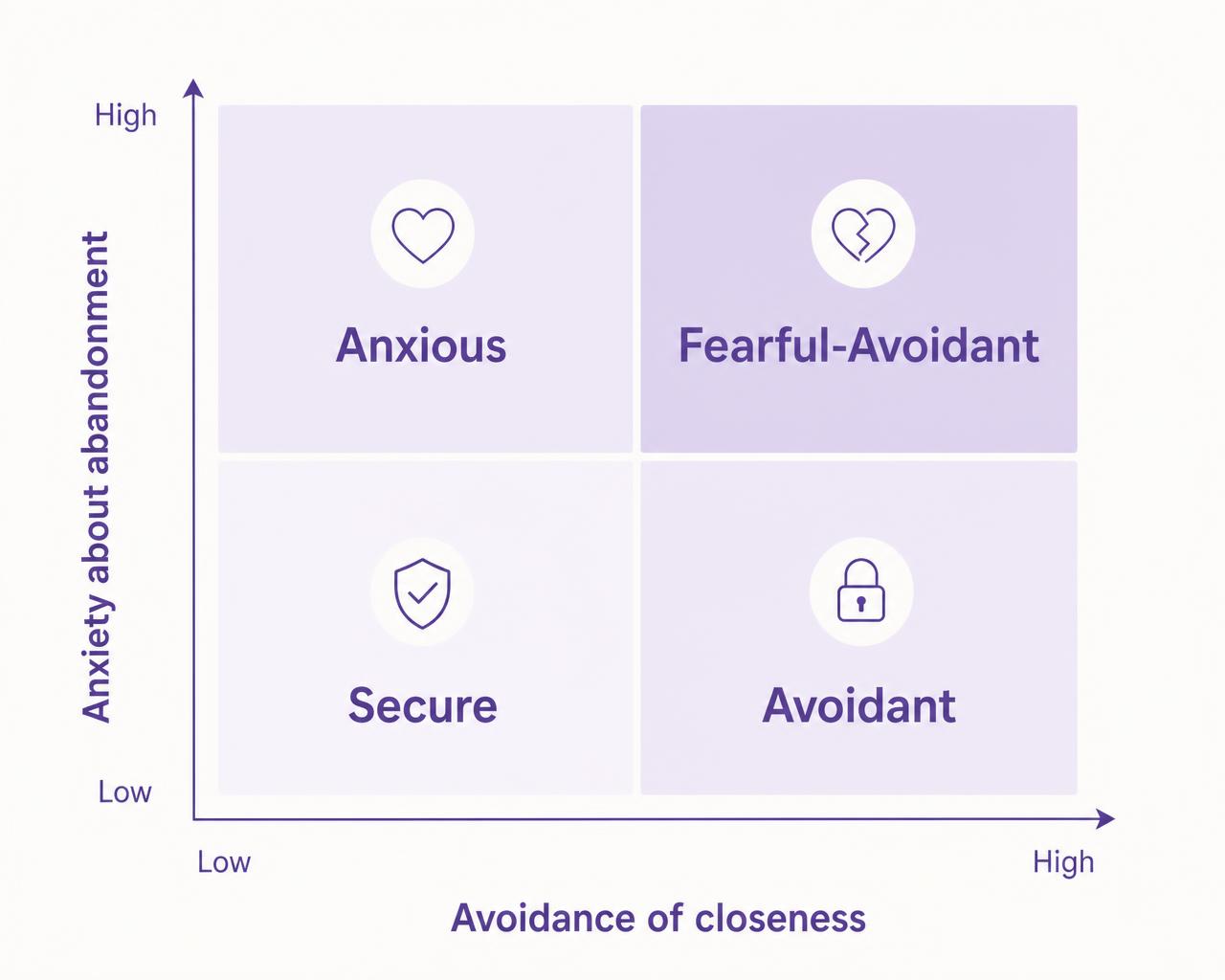
Most frameworks describe four types, though researchers sometimes group them into two axes: comfort with closeness, and anxiety about abandonment.
Secure
People with a secure attachment style are generally comfortable with closeness and don't spend much energy worrying about whether their partner will leave. They tend to communicate needs directly, handle conflict without catastrophising, and give their partners space without feeling threatened by it. Secure attachment doesn't mean a relationship is perfect — it means the foundation feels stable.
Anxious
Anxious attachment shows up as a heightened sensitivity to any sign that a partner might be pulling away. People in this pattern often seek a lot of reassurance, read deeply into silences or slow text replies, and can find themselves oscillating between deep connection and acute worry. It tends to stem from inconsistency in early caregiving — connection was available, but unpredictably so.
Avoidant (Dismissive-Avoidant)
Avoidant attachment looks like self-sufficiency taken to an extreme. People with this pattern value independence highly, tend to become uncomfortable when relationships feel too emotionally intense, and may withdraw when a partner seeks closeness. This isn't indifference — it's usually a learned response to having emotional needs go unmet or be dismissed early on.
Fearful-Avoidant (Disorganised)
Fearful-avoidant attachment sits at the intersection of the other two. People with this pattern genuinely want close relationships but also find them frightening. They may swing between seeking and pushing away connection, sometimes within the same relationship. This pattern is more common in people who experienced significant disruption or unpredictability in early caregiving.
Why It Matters in a Relationship
Attachment styles don't exist in a vacuum — they interact. An anxious person paired with an avoidant person can create a particular kind of tension: the more the anxious partner seeks closeness, the more the avoidant partner withdraws, which causes the anxious partner to push harder. Neither person is behaving badly. They're each following a pattern that once made sense to them.
Recognising your own pattern — and ideally your partner's — doesn't fix everything, but it changes the conversation. What looked like “you don't care” and “you're too needy” starts to look more like two people with different nervous systems trying to get the same thing: safety.
For couples, understanding attachment is often where a therapist will start. For individuals, it's usually the beginning of a longer process of understanding what you actually need from a relationship, and whether you're able to ask for it.
How to Find Out Your Attachment Style
The most reliable way to find your attachment style is a validated questionnaire — the kind developed by researchers like Chris Fraley, whose work is widely used in clinical settings. These assessments typically cover your comfort with closeness, how you respond to perceived rejection, and what you need from a partner when things get hard.
If you're already in a relationship, it's also worth considering how your style plays out with a specific person — which is a different question to your general pattern. Attachment tends to be activated in context, not just in the abstract.
Ready to see how this plays out in your relationship?
Take the free 8-question quiz — solo or with your partner. No login, no email, results in 2 minutes.
Begin →Relationship Reflection is a free paired relationship quiz — not an attachment style test specifically, but a natural next step once you know your pattern. It looks at how a relationship actually functions day to day: whether effort feels balanced, whether communication feels safe, whether you feel like a priority. You can take it on your own, or share it with your partner to see both perspectives together.